
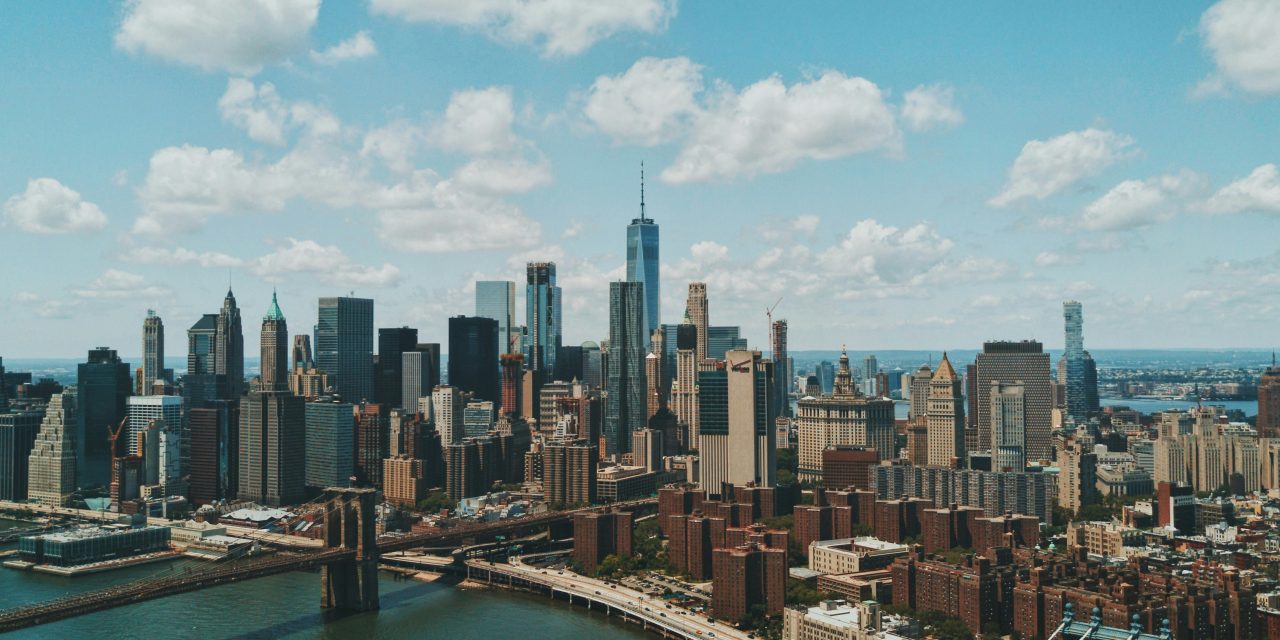
When most of us think of New York City, we picture skyscrapers, impossible traffic, Broadway, the Brooklyn Bridge, millions of crowded people, or a hundred other things. But I’m willing to bet that one thing you probably won’t think to add to the list is “great harbor.”
That dry attitude would confuse nearly all your ancestors, because for most of history, a good link to the water made a city great. In order to move large amounts of people and goods quickly and cheaply, a premodern civilization needed access to a harbor. The better your port, the more important your city might become. (In fact, we derive the words “importance” and “port” from the same Latin root: importare.) An ideal harbor needs three qualities: calm water (to keep ships safe and make loading and unloading easy), deep water (the closer you can get a boat to shore, the easier it is to unload), and freedom from winter ice (so no vessel gets trapped or blocked). New York, it turns out, combines all these, and is rather large to boot.
So when explorer Henry Hudson first sailed into that wide bay in 1609, he should have been excited. But while he did note that it was “a very good harbor for all windes” he was consumed with finding the Northwest Passage to China, so he headed straight up the long, deep river that now bears his name. That didn’t work out, of course, and he was forced to head back to Europe and report failure to his employer, the Dutch East India Company. Then—being a man of one idea—he promptly went to search again, finally freezing to death (abandoned by his crew) somewhere in what we now call Hudson’s Bay.
But his Dutch masters—canny businessmen—noted his report with interest. In addition to the harbor, Hudson had written that all along the river he had found friendly natives, quite willing to sell furs. In an age before central heating, animal furs were a hot commodity, and in the New World they could be had for next to nothing: a few glass beads, a hatchet, or some brightly colored cloth would do the trick. So those businessmen formed the Dutch West India Company and went to work rounding up some hardy settlers. In 1624, the first of those setters took ship to the New World.
Because the Dutch believed that laying claim to land meant you had to actually live on it, they initially scattered their colonists widely, with the majority going up the Hudson River to what they called Fort Orange (modern Albany). But in early 1626, the settlers had their first trouble with a hostile tribe, and seven men died. Almost simultaneously, the colonists voted to depose and banish their first governor for poor rulership, mishandling funds, and cheating Indians. They asked Peter Minuit to replace him as commander. Minuit decided immediately that the colonists were too scattered and vulnerable—they needed somewhere easily defensible, but still squarely on the trade routes. He decided the best option was a large, tongue-shaped island in the harbor; the Indian name sounded something like Manna-hat-ta (the best guess is that it meant “hilly island”).
And so, in the first real-estate deal on an island that would become notorious for them, Peter Minuit “purchased the Island Manhattes from the Indians for the value of 60 guilders” in 1626. An American historian during the 1800s translated that sum into $24 American dollars, which was repeated often enough to become legend. With the possible exceptions of the Louisiana Purchase or buying Alaska, it was the most momentous land deal ever made in America. The real estate value of the twenty-two square mile island of Manhattan is now worth somewhere considerably north of one trillion dollars—that’s $1,000,000,000,000 for you visual learners. It was, quite simply, a good deal.
Not, of course, that Minuit was cheating anybody. Sixty guilders was not pocket change (a West Indies Company private soldier in 1626 was paid 100 guilders per year) and to the tribesmen he bargained with, European trade goods like steel knives, iron hinges, and woven cloth were nearly priceless, because they could not possibly make them themselves. Further, according to Indian custom, they were selling merely the use of the land and could continue to use it themselves (and records indicate that they did, living on the upper end of Manhattan for another sixty-odd years). In short, at the time, everybody was happy with the deal. The colonists moved to the southern tip of the island, built a fort, and called the settlement “New Amsterdam.”
Unlike the Puritans to the north, who came to America for religious reasons, or the Virginians to the south looking for gold, New Amsterdam was always about business. It quickly became a thriving, partying, multi-lingual town. In 1664, the English decided that they wanted it and claimed it at the point of a cannon. It became part of the vast colony run by the King of England’s brother—James, the Duke of York (later crowned James II). The town was named “New York” in his honor, and that name stuck.
Though a busy city, New York remained only the third- or second-largest city in America until well after the Revolution. Then the Erie Canal connected the Great Lakes with the Hudson at Albany in 1825, and New York City became the natural gateway to the Midwest. Immigrants poured in from all over Europe, the city grew to include not only Manhattan but four other nearby boroughs, and today it is home to nearly nine million inhabitants: the premier financial, cultural, and business hub of America. If only Peter Minuit could have seen that forest of skyscrapers rising four centuries later from his quiet, hilly island of trickling streams, tall forests, and grazing deer! Who knows what he might have thought—or if he would have been willing to pay more than sixty guilders? ✤

James Goode enjoys helping people discover all sorts of new things, but his first love will always remain the oddities of history. Currently he teaches at both Logos Online School and New Saint Andrews College in Moscow, ID. You can keep up with his social shenanigans by finding @Goodeguystuff on X/Twitter.