

I recently visited the social media account for an ACCS school alumni to get details about an event. At the beginning of each and every post was a quote from a classic book. And I remember wondering, “Would our world be different if everyone did that?”
It would at least require deeper consideration of a post’s content, and might improve the social network world just a little bit. More importantly, it would point to a deeper way of life where we’re connected to other people and times. A life that is part of a greater story. A life where words matter.
On an opposite note, most of us were taught to say “thank you” and we diligently require it of our children. Why? Because regardless of how you feel, expressing thanks brings a reality home—you are not owed, others are important, say the right thing regardless of how you feel. What would change if “thank you” were removed from our cultural practice?
The point is this—seemingly minor and even unnoticed patterns can make a big difference. You might have heard the term “X factor”—that hard-to-define ingredient that makes the decisive difference. It’s the variable that separates “good” from “great” or explains why something works when the obvious factors don’t fully account for it. Schools spend energy on curriculum, teacher training, and planning of all kinds, with an estimated 16,000 hours spent by each student in school, and yet headmasters consistently say that parents are key. In my many years as a headmaster, I’ve seen the X factor over and over in people, in teams, in schools, and in families. And I agree with my peers. When it comes to classical Christian education, the X factor is parents.
And that brings us to this issue of The Classical Difference, where we explore ways parents can be the X factor in their kids’ classical Christian education—the force that brings it home and gives it the highest impact. Being the X factor means, at its root, being intentional about the rhythms of your family life. We hope to provide encouragement, ideas, and practices to help. It might mean instituting small practices—akin to saying “thank you” consistently. Or it might mean being open to new ideas—like adding a classic quote before every post, or asking our kids to read a commonplace from their most recent entry every night at the dinner table (commonplaces are a journal of quotes we keep as we read). Most of all, it’s a call to reignite an awareness our culture is losing—that the home is our central place, the foundation of our communities, where our unique story unfolds. It’s also a call to remember that while the current at your classical Christian school can help to carry your children to the destination you hope, the captain is still you.
Small adjustments lead to vast trajectory changes over time. Hopefully, the experiences shared in this issue will bring your own ideas to the surface, and chart a more intentional course. And not to worry—no calendar items added! ✤

David Goodwin
The Classical Difference
“All tends to the return of the simple truth that the private work is the great one and the public work the small. The human house is a paradox, for it is larger inside than out…”
~ G.K. Chesterton
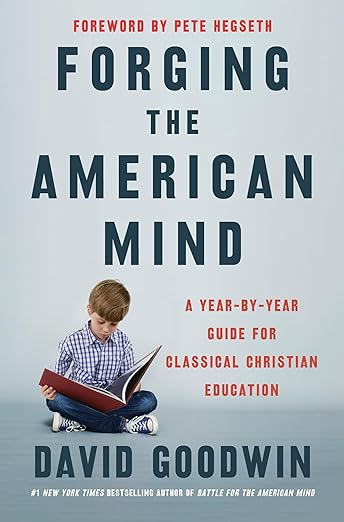
A Year-by-Year Guide for Classical Christian Education
Transforming K-12 Learning: Practices for Teaching Virtue and Wisdom
By David Goodwin
A followup to the #1 New York Times bestseller Battle for the American Mind
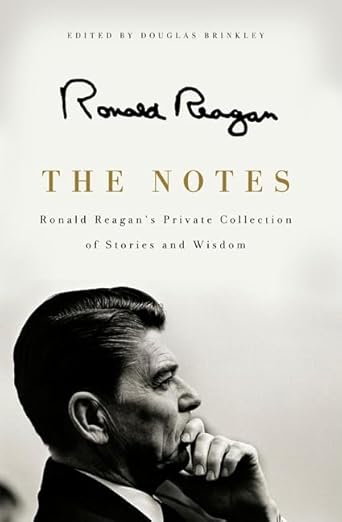
The Notes: Ronald Reagan’s Private Collection of Stories and Wisdom – A Presidential Retrospective of Intimate Thoughts and Inspiring Quotations

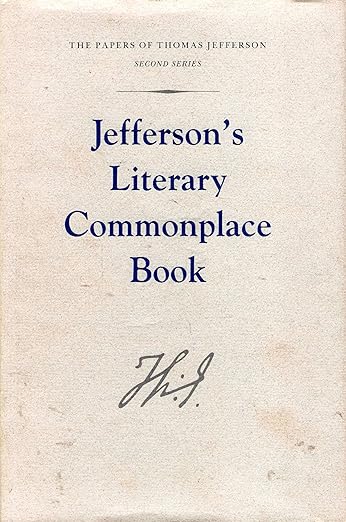 Thomas Jefferson
The Commonplace book of Thomas Jefferson, a repertory of his ideas on government
View the Book