
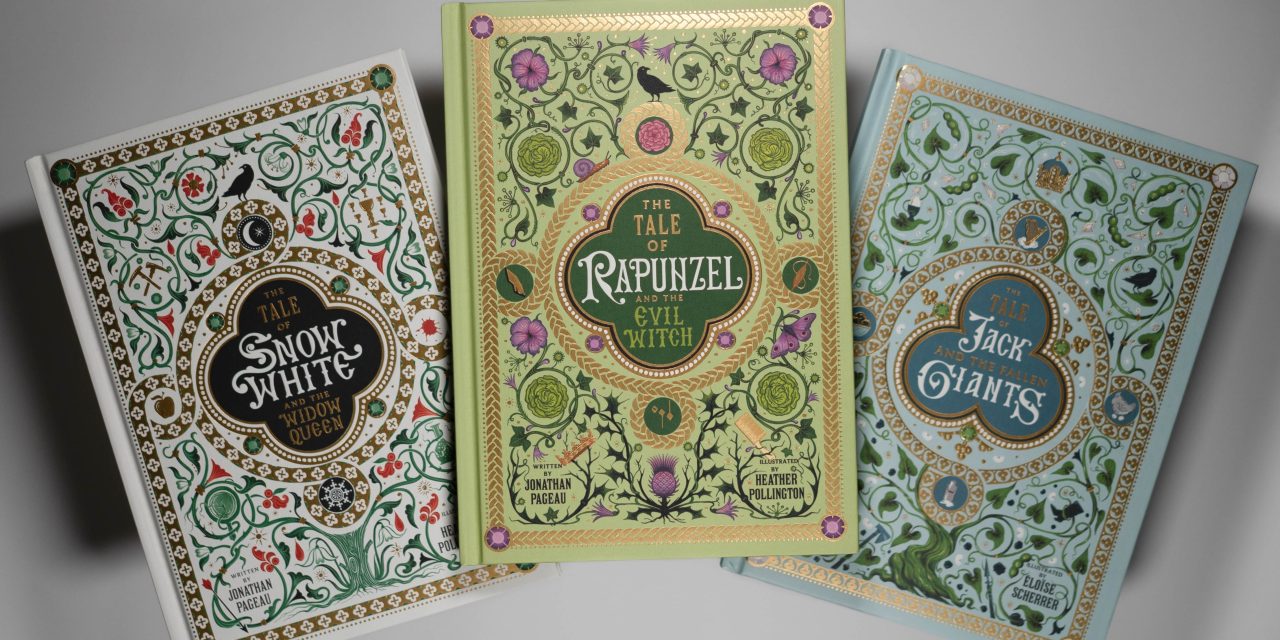
Tales for Once and Ever
An Interview with Jonathan Pageau
A growing number of parents are rejecting watered-down Disney retellings of fairy tales and returning to the undiluted originals. What makes these ancient stories compelling today? ACCS’s Devin O’Donnell sat down with scholar and author Jonathan Pageau, whose beautiful new book series brings these classic tales to life for both children and adults, revealing the timeless wisdom hidden in the shadow of “once upon a time.”
Q: A defining principle of classical Christian education is ad fontes—going back to the (original) sources. Why do you think fairy tales are such an important source?
A: They escape some of the classical and modern errors about what is true, which is that we are obsessed with authors, and we’re kind of obsessed with the idea of the personal genius.
What’s great about the fairy tales is they don’t really have authors. They are in some ways tales that have sprung from very ancient, ancient memories—oral tales that have been told generation to generation. And so for that reason, they actually contain the pattern of human attention in a way that very few other stories do, maybe next to Scripture. They are probably some of the deepest stories we have, because by process of refinement and iteration they would be retold and remembered and retold and remembered.
Why would you tell the story for 5,000 years if it doesn’t have in it something that is essentially true about human nature? That’s why, I think, the fairy tales are very important right now, because the literary world, you could say, is ending [its] very long period of time, which started maybe at the printing press, and is now turning into something else. I think that this moment is a perfect time to revisit these deep, deep stories.
Q: What made you choose these particular fairy tales to start with—Rapunzel and the Evil Witch, Jack and the Fallen Giants, and Snow White and the Widow Queen? Why these stories in particular?
A: To be honest, I think that there are two mechanisms by which I chose the stories we’re going to retell. One was to look at the stories which really hold strong in the modern imagination still. For all kinds of reasons, Snow White, for example, is probably the most known fairy tale, in part because of Disney. Sleeping Beauty, Cinderella, and Rapunzel—maybe a little less [known] but still quite strong. And I wanted to kind of retell them in a way that would make them very bright for people. People should be able to see how powerful and how important they are.
The other [reason] was [that] I wanted to have two lines in the series of fairy tales—one which was a kind of feminine line and one which was a masculine line, because I wanted to also deal with the relationship between men and women, the relationship between beauty and seduction and how is it that we find each other and how is it that we come together.
The other ones I chose are less known, because for some reason in Western Europe and in North America the female-led [tales] are more known. But for sure, Jack and the Beanstalk is quite popular, so we chose that as the first one. Then the others will be a little harder. For example, we have The Valiant Tailor, which is a giant-killing story. And then we’ll have a story which is going to be essentially The Emperor’s New Clothes [that] is also a more kind of male story.
Q: In Jack and the Fallen Giants, we see the archetypal monster-slaying motif that is present throughout ancient story-telling, such as David and Goliath or Beowulf and Grendel. What about monsters and giants is so important?
A: Well, it really depends on the story, but for sure, the monster is something which is very powerful, but that you don’t master or that you don’t understand. [The concept of] “understanding” is also a good one because monsters are always something that is unreasonable. Either they’re hybrids, like dragons, or they’re too big or too small, or they’re unreasonable.
And therefore it is quite normal for boy stories to want to deal with that because they present themselves as puzzles, [or] as obstacles. [They can function] as guardians of things that are important. And therefore, you have to be able to deal with them. You have to be able to trick them. You have to be able to solve them. You have to be able to kill them in order to access the thing that they’re guarding.
And so the giant is as much like trying to learn a new coding language, as it is some obstacle in your professional life, as it is a sin that you have that’s stopping you from being who you need to be. You know [what] you need to be, but you have this puzzle, this thing in you, these desires that are too strong and that are pulling you. And so that’s why the monster is such a great image, because it’s all those things at once. It’s a structure. It’s a structure of encountering something that doesn’t make sense or that is threatening or that is unreasonable, and then finding a way across that bridge.
Jack is a very particular story, because in the story the giants represent something like the dangers of masculine hierarchy. They represent in some ways the young guy who goes to get a job and his boss basically just wants to devour his energy and doesn’t want to give him any opportunity. [It’s a] corrupt hierarchy. … They’re preventing him from being able to access the patterns that he would need in order to take care of his mother, in order to live that life. That’s why in some ways they’re more like, kind of, fallen angels. That’s why in our version, we call them Jack and the Fallen Giants, because they’re more like these principalities that are trying to devour you instead of offering worship to God, if you think of the fallen angels in that way.
Q: What is so important about symbolism right now, today?
A: For many decades now, we’ve been convinced by various people that the world is “flat,” that the world can be reduced to its parts.
As Christians, we know it’s not true, but sometimes we don’t completely understand how that works. And so, when we talk about symbolism, what we’re talking about is basically the patterns by which the world manifests itself, the patterns by which the world is ordered. That’s what we mean by symbolism. There are natural ways and better ways by which we organize our families. There are natural ways and better ways by which we organize our societies. And it’s the same also for events. There’s a reason why we tell stories in certain orders in certain ways, because there are better ways—those that are memorable and strong.
None of the fairy tales that we remember and that we love are arbitrary. None of them. It’s not possible. You couldn’t remember something arbitrary for thousands of years or even hundreds of years. Even if you don’t know why you remember it and why you care about it, it’s tapping into some very, very deep pattern that you might not even recognize. You don’t have to understand the symbolism for the story to do what it needs to do. Parents can reassure themselves that these stories are doing the work.
And so, the reason why we talk about symbolism is because for the past decades also, as we’ve been told that the world is flat, you could say the enemies of Christianity have become symbolism experts and they’ve been able to weaponize symbolism against us and against the Christian story. And therefore, if Christians aren’t able again to see the beauty and the strength of the stories that are in Scripture, and see this beautiful rhythm that God put there, that God created, then we’re in much more danger of being tricked by the media, by the news, by the movies, by the TV series, all these things that our children end up consuming. We don’t have a way of discerning it. We should have figured out in the 1970s that a publicly funded TV show about how monsters are your friends was probably not a great idea and that it was going to lead to where we are right now.
Q: Where did you find your original sources?
A: The original sources for fairy tales are of course as old as time. We have the main transcriptions that happened in the 18th and 19th century: Grimm, Perrault, or Joseph Jacobs in the case of Jack and the Beanstalk. But what is important to know is that the people who transcribed these stories are not the source, and that variations on these stories are as ancient as human memory. The tales are “ground up” stories, stories told from the dawn of time that were remembered, retold, refined, adapted, then retold refined and adapted again and again until they became these jewels of human attention.
This is why the stories rhyme with each other even in their differences—sleeping maidens, horrible stepmothers, being lost in the woods, saved by princes. In our versions we tried to celebrate and acknowledge the transcriptions we have come to love so much, but we also wanted to emphasize the rhyming and contrast of the stories, playing them with and against each other to create a symphonic effect.
Q: Most recently, you published Little Red Riding Hood. Tell us more about that choice. What should we pay attention to in that fairy tale?
A: Little Red Riding Hood is a standalone book in our series. It’s not directly in the narrative arc [of the others]. It’s kind of in the same world and has the same style. But the story of Little Red Riding Hood is less told now, and in some ways, it’s one of those stories that’s been a little bit pushed to the side. And it’s a reflection of our moment, or you could say a reflection of the past twenty years or so. But now is a time to remember this story. It deals with the danger of the stranger, [but] that’s not the only thing the story is about. … It’s really about preserving lineage. … It’s also about the wolf who transgresses hospitality. … And it’s about staying on the path. ✤
Tune in to the complete interview! They cover topics like AI, the post-print world, deeper meanings in other favorite fairy tales like Snow White and Rapunzel, and more: ClassicalDispatch.org.
Get 15% off at Symbolic World Press with code: ACCSSAVES

Jonathan Pageau is an influential French-Canadian public intellectual, known for exploring the deeper patterns and symbolism underlying contemporary culture, faith, and society. Through his widely followed YouTube channel, podcast, blog, and platform for online courses, The Symbolic World, he engages hundreds of thousands of followers in discussions about how timeless stories and ancient symbols illuminate modern life.